Raw Cookie Dough Safety: A Flour, Egg, and No-Bake Dough Decision Plan
A practical raw cookie dough safety plan that separates flour, egg, and ready-to-eat ingredient hazards, with safer alternatives and a cleanup workflow.
Safety fact check included
CookNest Daily articles surface source counts, timing assumptions, kitchen-test notes, and food-safety caveats. This label means editorial safety review, not a substitute for local food-code or medical guidance.
Raw cookie dough has two famous ingredients and one frequently missed safety problem. People often remove the egg and assume the risk is gone. That solves only one branch of the decision tree. Ordinary flour is raw, and the manufacturing steps used to mill and package it do not necessarily include a validated kill step. A dough made with regular flour, butter, sugar, and no egg is therefore not automatically ready to eat.
The useful question is not “How risky is one spoonful?” No home cook can see whether a particular bag or egg carries a pathogen. The useful question is: Was every ingredient selected and handled for ready-to-eat use, or will the complete dough receive its intended cooking step? FDA’s consumer guidance says not to eat raw dough or batter and identifies both uncooked flour and raw eggs as possible sources of germs (FDA). USDA likewise treats flour as a raw food and advises cooking foods made with it according to directions rather than eating raw dough (USDA FSIS).
The 30-second decision plan
Use this sequence before mixing:
- Will the dough be fully baked? If yes, keep it as bake-only dough: prevent tasting, contain flour, avoid cross-contamination, and bake according to a tested recipe or package directions.
- Will the dough be eaten without baking? If yes, ordinary flour is not the right ingredient. Use only flour, a mix, or a finished dough that its manufacturer explicitly identifies as ready to eat or as having received an appropriate pathogen-reduction treatment.
- Does the no-bake formula contain egg? Use a pasteurized egg product intended for the application, or choose an egg-free formula. “Fresh,” local, organic, or clean-looking shell eggs are not substitutes for pasteurization.
- Are all remaining ingredients ready to eat? Check additions such as cake mix, brownie mix, raw starch, or another powdered baking mix. A no-bake label on the recipe does not transform a bake-only ingredient.
- Can you keep the ready-to-eat workflow separate? Clean hands, tools, surfaces, storage containers, and serving utensils matter after the ingredient decision.
If any answer is uncertain, change the plan: bake the intended product without sampling the uncooked mixture, or use a clearly labeled commercial ready-to-eat alternative.
Hazard matrix: three lanes, not one vague “raw” category
| Ingredient lane | What the hazard is | Common mistaken shortcut | Better control |
|---|---|---|---|
| Ordinary wheat flour and flour-based baking mixes | Flour can carry Shiga toxin-producing E. coli or Salmonella even though it is dry | “It looks clean,” “dry foods cannot support pathogens,” or “the egg-free dough is safe” | Treat as raw; prevent eating and spread; cook the complete food as intended, or choose a manufacturer-designated ready-to-eat ingredient |
| Raw shell egg | Raw or undercooked egg can carry Salmonella | Removing only the white, using a farm egg, washing the shell, or judging freshness by appearance | For a no-cook formula, use an appropriate pasteurized egg product or an egg-free formulation; for cooked foods, follow established egg-safety guidance |
| Ready-to-eat ingredients | Ingredients may be safe as sold but can be contaminated by raw flour, egg, hands, bowls, scoops, counters, or towels | “Chocolate chips and butter are safe, so the finished bowl is safe” | Start with a clean ready-to-eat station, verify every powder or mix, and prevent contact with bake-only ingredients |
The flour lane is supported by outbreak evidence, not just theoretical concern. A U.S. investigation identified 56 cases across 24 states and linked illness to contaminated flour; tasting unbaked dough or batter was strongly associated with infection, and outbreak strains were isolated from flour (Crowe et al., 2017). A Canadian investigation identified 29 cases in six provinces, plus a travel-associated U.S. case, tied to uncooked flour exposure (Morton et al., 2017). A New Zealand outbreak investigation found an association between illness and uncooked baking mixture and recovered the outbreak strain from flour in homes and unopened retail packs (McCallum et al., 2013).
Those examples also show why appearance, smell, brand familiarity, and pantry history cannot clear a bag for raw use. Contamination can be intermittent and invisible. A recall check is useful when an alert exists, but “not recalled” does not mean “ready to eat.”
Why the “just one taste” habit persists
Cookie dough is culturally treated as a treat before the treat. That habit can make a clear package instruction feel optional. In the 2009 U.S. outbreak associated with ready-to-bake commercial prepackaged cookie dough, investigators identified 77 patients in 30 states; 35 were hospitalized and 10 developed hemolytic-uremic syndrome. Most case patients who reported eating the product had consumed it uncooked despite bake instructions (Neil et al., 2012). “Commercial” and “refrigerated” therefore do not equal ready to eat; the intended use on the label matters.
Survey evidence helps explain the communication gap. In an FDA national probability survey of 2,171 U.S. adults, 35% reported tasting or eating something containing uncooked flour during the prior 12 months, while respondents generally underestimated the chance that uncooked flour contained harmful germs (Verrill et al., 2022). A separate survey found low awareness of flour recalls and outbreaks and reported that safety messages pairing recommendations with an explanation of their benefit were more persuasive than recommendations alone (Feng and Archila-Godínez, 2021).
That is why the rule should include the reason: skip uncooked bake-only dough because both flour and egg can introduce hazards, and because a small sample bypasses the cooking step designed for the food. The goal is not to make cookies frightening. It is to move the pleasure to a baked cookie or a formulation actually designed for no-bake eating.
A batch-size exposure calculation
A batch changes how often people contact the uncooked mixture. Suppose a 48-cookie batch is made for four people, and each person takes two tastes while portioning. That creates:
4 people × 2 tastes = 8 raw-dough contacts per batch.
If the household makes that batch monthly, the practice creates 8 × 12 = 96 raw contacts per year. A no-tasting, bake-only workflow reduces the planned raw contacts to zero without changing the baked-cookie yield.
A hypothetical probability example shows why repeated opportunities matter, but it must not be mistaken for a measured cookie-dough risk. If each contact had an assumed independent 0.1% chance of exposure, the chance of at least one exposure across eight contacts would be:
1 − (1 − 0.001)^8 = 0.00797, or about 0.8%.
Across 48 hypothetical independent contacts, it would be about 4.7%. Real flour contacts are not reliably independent: several tastes can share one contaminated batch, contamination may be clustered, dose varies, and the true probability for a specific bag is unknown. The calculation is an exposure-opportunity model, not a prediction of illness. Its practical message is narrower: increasing tastes and tasters increases opportunities; removing raw tasting removes those avoidable opportunities.
Safe-alternative decision table
| What you want | Choose | Avoid | Final check |
|---|---|---|---|
| Traditional baked cookies | A standard recipe or refrigerated dough intended for baking | Sampling during mixing, scooping, or before the center is baked | Follow recipe or package baking directions; keep utensils used on raw dough out of serving food |
| Spoonable “edible cookie dough” | A finished commercial product explicitly labeled edible or ready to eat | Assuming any refrigerated tube is edible | Follow storage and use instructions; check the label every time |
| Homemade no-bake dough | A recipe built entirely from manufacturer-designated ready-to-eat ingredients, with pasteurized egg if egg is used | Ordinary flour, ordinary cake mix, raw starch, or raw shell egg | Verify each ingredient rather than relying on the recipe title |
| Cookie-dough flavor in another dessert | Ready-to-eat cookie-dough pieces or another ingredient labeled for that use | Folding chunks of ordinary raw baking dough into ice cream | Keep the cold dessert and utensils away from the bake-only station |
| Baking activity with children | Mix and shape with close supervision, then bake before eating | Flour play, tasting, or letting flour-covered hands reach snacks | Wash hands and the workstation immediately after the raw phase |
| A flour-free bite | A tested no-bake recipe whose ingredients are all ready to eat | Replacing flour with another uncooked baking mix without checking its intended use | Check powdered ingredients and allergen controls; refrigerate if the recipe requires it |
A bread dough is governed by the same flour principle even if it contains no egg. If you are making Dutch oven no-knead bread, wait for the baked loaf rather than sampling the dough. For egg-containing recipes, use an evidence-based cooking plan and see the site’s egg doneness temperature chart; texture descriptions do not by themselves establish that a raw-dough formula is safe.
Why this guide does not give a home flour heat-treatment recipe
It is tempting to turn a research result into a universal oven shortcut. That would overstate what one home setup can guarantee. A household-oven study evaluated specific flour depths, temperatures, times, organisms, equipment, sampling, and thermal profiles. It found that home-oven heating has potential as an inactivation treatment, while also showing that microbial reduction depends on the actual process (Jung and Schaffner, 2022).
That evidence does not justify copying a single air-temperature and timer setting into every kitchen. Flour depth, pan geometry, oven cycling, starting temperature, water activity, mixing uniformity, cool spots, thermometer placement, and post-treatment recontamination can all differ. An oven display measures or estimates oven air, not the coldest point in every particle of flour. A microwave adds its own uneven-heating problem.
For that reason, this article does not invent a home flour time/temperature combination. The lower-uncertainty option for no-bake dough is a commercially treated ingredient or finished product whose maker designates it ready to eat. If the package says the flour or mix must be cooked, honor that instruction.
Cross-contamination cleanup workflow
Raw flour spreads differently from raw meat juice: it can dust a wide area, settle on handles, and travel on sleeves or towels. Treat cleanup as a sequence, not a final swipe.
- Stop ready-to-eat work. Move fruit, baked cookies, decorations, clean plates, and serving utensils away from the raw-dough zone. Do not eat while cleaning.
- Contain the dry spill. Avoid vigorous brushing, shaking a towel, or blowing flour into the air. Gather visible flour carefully with a disposable towel or other low-dust method, then discard it.
- Move tools without spreading residue. Put the bowl, beaters, scoop, measuring cups, and spatula directly into the wash area. Do not set them on a clean counter. Keep flour-coated packaging away from serving areas.
- Wash hands with soap and running water. Clean between fingers, around nails, and over wrists. Do this after handling flour, raw dough, or raw egg and before touching ready-to-eat food.
- Wash dishes and utensils. Use hot, soapy water or a dishwasher when items are dishwasher-safe. Clean the sink area if raw dough or egg contacted it. A flour-dusted sponge or dishcloth can redistribute residue.
- Clean the work surface. Remove soil first with the cleaner appropriate for the counter. If a sanitizer is used, follow its label for surface compatibility, dilution, contact time, rinsing, and ventilation; do not improvise chemical mixtures.
- Handle linens as contaminated. Replace towels and aprons that received flour or egg. Carry them without shaking and launder them before reuse.
- Reset the station. Wash hands again, bring out clean serving tools, and only then return baked or ready-to-eat food to the counter.
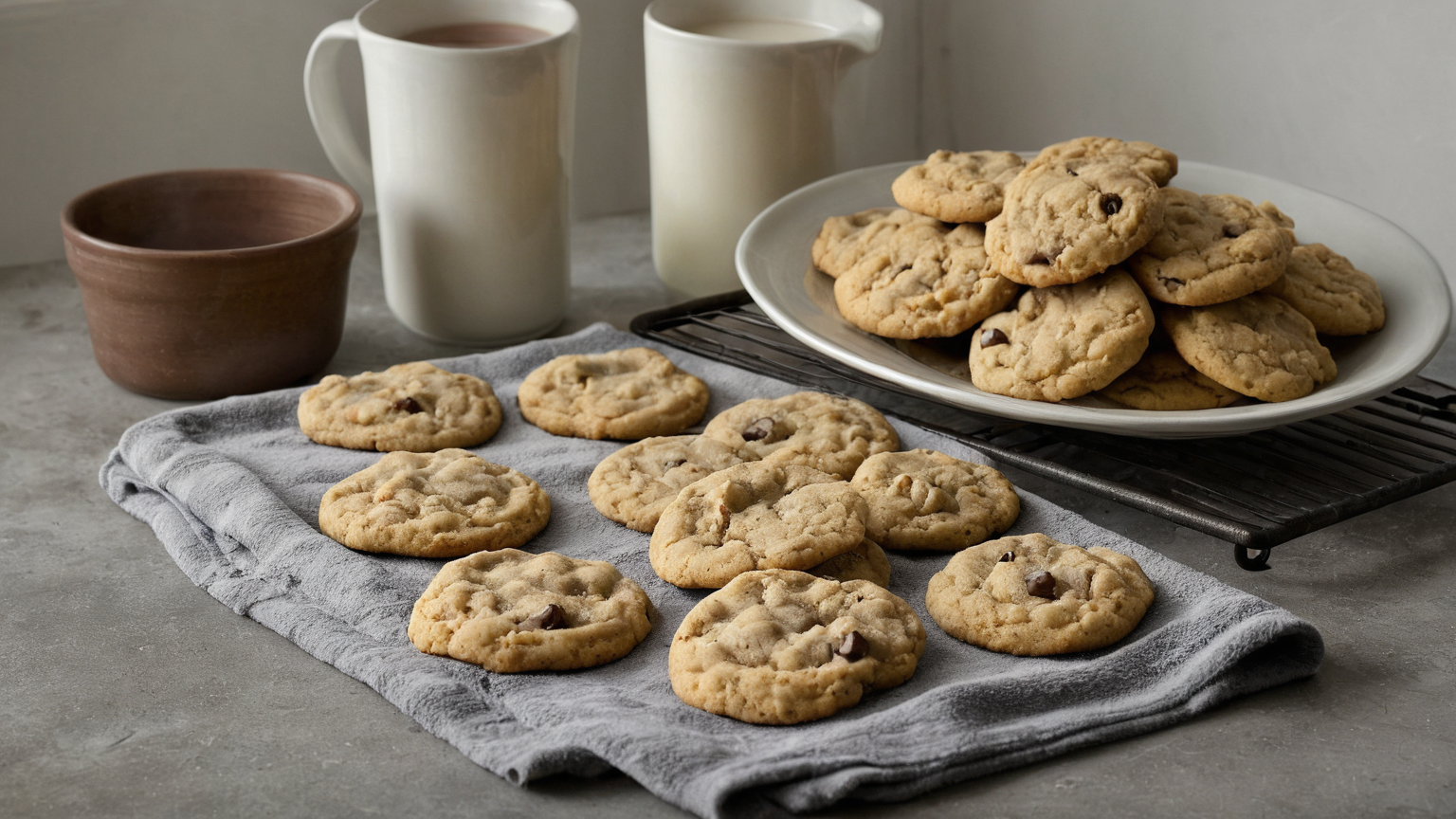
This is the same separation logic used in a broader cutting-board cross-contamination system. The key question is whether a raw ingredient or contaminated hand touched something that will receive no later cooking step. For a complete kitchen routine covering cooking, cooling, storage, and reheating, use the meal-prep food safety temperatures guide.
What to do when the plan breaks
If someone takes a taste, do not try to induce vomiting and do not use another taste to judge the batch. Stop further uncooked eating, clean the station, and preserve useful package information such as the brand, product name, lot code, and use-by date. Check current public-health recall notices if a product alert is suspected.
Watch for symptoms of foodborne illness and seek medical advice when symptoms are severe or the person is at higher risk. Prompt care is especially important for bloody diarrhea, signs of dehydration, persistent vomiting, severe abdominal pain, or concerning symptoms in a young child, older adult, pregnant person, or immunocompromised person. This article cannot diagnose an exposure or determine whether a particular taste will cause illness.
Do not serve the raw mixture to “use it up.” If its ingredient status is uncertain and it cannot be confidently handled according to its intended cooking instructions, discard it. If raw dough contacted a bowl of ready-to-eat chips, frosting, fruit, or ice cream, treat that food as cross-contaminated rather than picking out visible pieces.
Limitations and evidence boundaries
Outbreak reports establish that flour and flour-containing dough have transmitted illness, but they do not provide a universal probability for every spoonful. Surveillance misses some illnesses, product contamination can be uneven, and outbreak investigations focus on events large enough to detect. Survey studies describe self-reported knowledge and behavior; they do not measure contamination in each respondent’s pantry.
The hazard matrix also cannot validate a product. Formulations and manufacturing processes change, so the current package is the authority for whether a commercial item is bake-only or ready to eat. “Heat treated” language should be paired with a clear intended-use statement from the manufacturer rather than interpreted from marketing alone.
Egg-free addresses the egg lane, not the flour lane. Gluten-free addresses gluten, not microbial safety. Vegan addresses animal ingredients, not whether a starch or mix received a kill step. Freezing, refrigerating, smelling, or visually inspecting ordinary raw dough does not convert it into a ready-to-eat food. Finally, a ready-to-eat formulation still requires clean handling and any refrigeration specified by its manufacturer.
Frequently asked questions
Is raw cookie dough unsafe only because of eggs?
No. Ordinary flour is a raw agricultural product and can carry harmful bacteria, while raw shell eggs can add a separate Salmonella hazard. Removing eggs does not make conventional flour safe to eat raw.
Is store-bought edible cookie dough automatically safe?
Use only a product that the manufacturer clearly labels ready to eat or edible. Keep it refrigerated when required and follow its package directions. Ordinary refrigerated break-and-bake dough is still intended for baking.
Can I make edible dough with regular flour heated in my oven or microwave?
Do not improvise a universal time-and-temperature treatment. Appliance performance, flour depth, moisture, mixing, and cold spots affect the process. Choose flour or a mix specifically identified as ready to eat or commercially treated for that use.
Can children play with homemade raw flour dough?
FDA advises against children eating or playing with raw dough, including dough used for crafts, because flour can spread to hands and surfaces and children can become seriously ill from foodborne infection (FDA).
What should I do after raw dough spills on the counter?
Keep ready-to-eat food away, contain dry flour without creating a dust cloud, wash hands, wash bowls and tools with hot soapy water, clean the counter, and replace contaminated towels before resuming food preparation. USDA’s raw-flour guidance emphasizes cleaning bowls, utensils, and surfaces after use and washing hands after handling flour or raw dough (USDA FSIS).
Bottom line
A reliable raw-cookie-dough plan separates three questions. Flour: is it ordinary bake-only flour or explicitly ready to eat? Egg: is a no-cook formula egg-free or using an appropriate pasteurized product? Workflow: can ready-to-eat ingredients stay protected from raw flour, egg, hands, tools, and towels? If the product is intended for baking, do not sample it before that step. If the goal is spoonable dough, start with a formulation and ingredients designed for ready-to-eat use rather than trying to rescue a conventional recipe with assumptions.